
How to Solve Word Jumbles Faster: Anagram Tips Backed by Cognitive Science
- Split vowels from consonants first. Your word-recognition system keys on the consonant skeleton, so park the vowels and read the consonants.
- Peel common affixes before shuffling. About 28% of seven-letter words carry a common affix (-ING, -ED, -ER, -TION, UN-, RE-), in one 234,210-word list analysis. Locking -ING turns a 7-letter jumble into a 4-letter one.
- Lock forced pairs. Q goes with U in 99.6% of words containing Q; glue high-frequency bigrams (TH, HE, IN, ER) and build outward from the word's edges.
- Start from the rarest letter. Q, Z, X, J and K each appear in under 1% of English text — they shrink the candidate space more than any other single move.
- In Bubble Word Jam, apply the category before the letters. Ask "which member of this category fits these letters?" — a far smaller search than "what words can these letters make?"
Skilled anagram solving is not a mysterious talent — it is a trainable pattern-recognition skill built on the same machinery your brain uses for ordinary reading. Decades of psycholinguistic research, plus large-scale letter-frequency data, converge on a small set of techniques that strong players share. This guide walks through that evidence in plain terms, with worked examples you can apply to your next Bubble Word Jam board. In a hurry? The word finder matches your level from any 2-3 words — then come back and learn the loop.
- ✓ Why your brain half-solves jumbles for you — and when it sabotages you
- ✓ The vowel/consonant split that exposes a rack's word shapes
- ✓ Affix peeling: turn 7-letter jumbles into 4-letter ones
- ✓ Forced pairs and rare-letter anchors that shrink the search space
- ✓ The letter and bigram frequency tables worth memorizing
- ✓ How to use Bubble Word Jam's hidden categories as a hard constraint
- ✓ What practice will — and won't — make faster
Why are word jumbles hard in the first place?
The single most useful finding for players is that your reading system does not treat letter order as rigid. In masked-priming experiments, a scrambled string like jugde speeds recognition of JUDGE far more than a string with different letters — the famous transposed-letter effect. A jumble is never noise to your visual system: because it contains exactly the same letters as the answer, it weakly activates the answer before you have consciously arranged anything. That is why solutions sometimes just "pop out."
Two wrinkles map directly onto strategy. First, the letters at the beginning and end of a word are "stickier" — they anchor word identity, which is why changing your candidate's first letter feels like changing the whole word. Second, your brain weights the consonant skeleton more heavily than the vowels: scrambling two consonants (caniso → CASINO) barely slows readers down, while scrambling two vowels does much less. Fix the consonants and let the vowels float, and you are searching the way your lexical system already works.
Finally, jumbles are hardest when the scramble fights your statistics. Classic studies show solution time depends on the bigram frequency of the letter pairs in the scramble, on how pronounceable the scramble is as a fake word, and above all on the frequency of the solution word — common words pop out, rare ones resist. And tight, over-learned chunks like -ING or -TION are cognitively hard to break apart, so an anagram containing a wrong -ING is a fixation trap. Every technique below is a way of exploiting — or escaping — these facts.
What are the core anagram-solving techniques?
1. Split vowels from consonants
The most universally recommended first move. Vowels make up roughly 40% of letters in dictionary words (in one analysis of a 234,210-word English word list), and English spelling alternates vowels and consonants with high regularity — so the vowel count in your rack immediately constrains the shape of any answer. A seven-letter rack with three vowels admits many long-word shapes; a rack with one vowel points to short words or consonant-cluster-heavy answers.
Worked example: the rack A E L P R S T splits into vowels A E and consonants L P R S T. With only two vowels, the answer cannot contain three syllable nuclei — and the consonant string LPRST already suggests the ST pair. (We solve this rack completely in the frequency section below.)
2. Peel common prefixes and suffixes
The highest-leverage move for long jumbles. If your letters can supply a common ending — -ING, -ED, -ER, -EST, -LY, -TION, -NESS, -MENT, -OUS — move those letters aside and unscramble only what remains. The same works from the front with UN-, RE-, IN-, DIS-, PRE-. In the same word-list analysis, about 28% of seven-letter words carry at least one common affix.
Worked examples: A E G I M N T → peel -ING → the remaining A E M T resolves to TEAM at a glance → TEAMING. And E E I L N R S T → peel RE- → LISTEN → RELISTEN. One caution from the chunk-decomposition research: test an affix hypothesis quickly and discard it decisively if the leftover letters do not resolve — a false chunk you refuse to release is the most common cause of being stuck.
| Affix | % of dictionary words | Affix | % of dictionary words |
|---|---|---|---|
| UN- | 6.2 | -ION | 2.9 |
| -LY | 4.9 | -OUS | 2.7 |
| -ER | 4.7 | -TION | 2.5 |
| -AL | 4.5 | -ING | 2.4 |
| -ED | 3.9 | RE- | 2.3 |
| -NESS | 3.0 | IN- | 2.3 |
Bottom line: you do not need this table memorized — you need the habit. Before any shuffle, spend two seconds asking "does this rack contain UN-, RE-, -ING, -ED, -ER or -TION?" Roughly one seven-letter word in four says yes.
3. Lock forced pairs and consonant clusters
Some consonant pairs behave as single tiles in English spelling and should be glued together before you shuffle anything else: TH, CH, SH, PH, WH, CK, ST, QU, plus blends like BR, CR, DR, FR, GR, PR, TR and STR. The strongest constraint in the language is Q→U: in that word list, 99.6% of words containing Q also contain QU, so never spend mental cycles on Q-without-U hypotheses. Among seven-letter words in the same analysis, -ER appears in 13.4%, RE in 7.3%, ST in 5.7%, SH in 4.2% and CH in 3.9%. Doubled letters (LL, EE, SS, OO, TT) are the other free anchor — they are visually distinctive and reliably mark a word's interior.
4. Start from the most constrained letter
Rare letters restrict the hypothesis space far more than common ones. In Norvig's Google Books counts, Q (0.12% of text), Z (0.09%), J (0.16%), X (0.23%) and K (0.54%) each appear in a tiny fraction of words, so any answer must come from that small set. A K invites -CK, -SK, -NK endings; a Z invites -IZE or -ZZ-; an X invites -OX, -EX or EX-. The classic demonstration: given the letters ACIIPST plus an F on the board, a top Scrabble player produced PACIFIST in five seconds — not by checking permutations, but because -IST and PAC- are high-frequency chunks and the rare C and F tightly frame the answer.
5. Stuck? Reshuffle, say it aloud, or walk away
Physically rearranging the letters — or reading the string backward — breaks the misleading adjacencies the scramble presented you with. Saying the letters aloud recruits phonological processing, which catches patterns pure visual scanning misses. And when nothing works, stop: a meta-analysis of 117 incubation studies found that setting a problem aside measurably improves solution rates, because the break lets your wrong fixation decay. In game terms: skip the level, clear another one, come back.
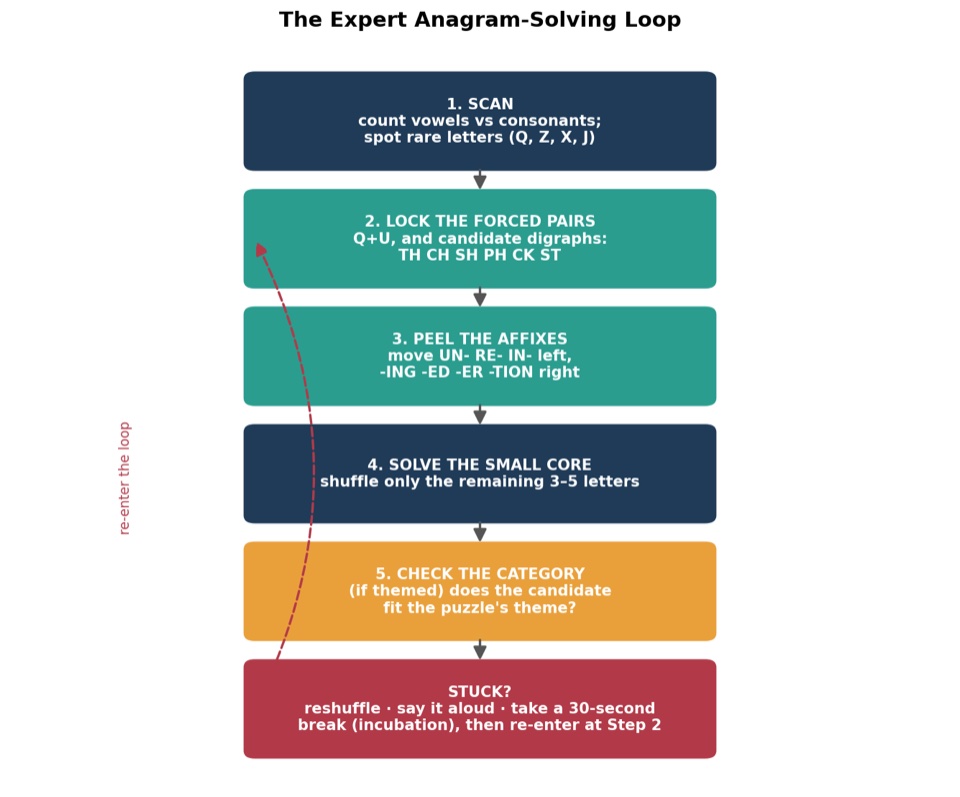
THE 60-SECOND SOLVING LOOP — copy this
[ ] 1. Count vowels vs consonants (~40% of letters are vowels)
[ ] 2. Lock forced pairs: QU first, then TH CH SH PH CK ST
[ ] 3. Peel affixes: UN- RE- IN- left · -ING -ED -ER -TION right
[ ] 4. Anchor the rarest letter (Q Z X J K) with its usual partners
[ ] 5. Shuffle only the remaining 3-5 letter core
[ ] 6. Themed board? Test 5-8 category members against the letters
STUCK > 30s → reshuffle · say it aloud · switch level, come back
Still staring at one stubborn word? That is what reference tools are for. Our word finder matches your exact Bubble Word Jam level version from any 2-3 words on your board, and the level index lists every category in game order — check the answer, see the pattern you missed, and keep moving.
Which letters and bigrams are most common — and how do you use that?
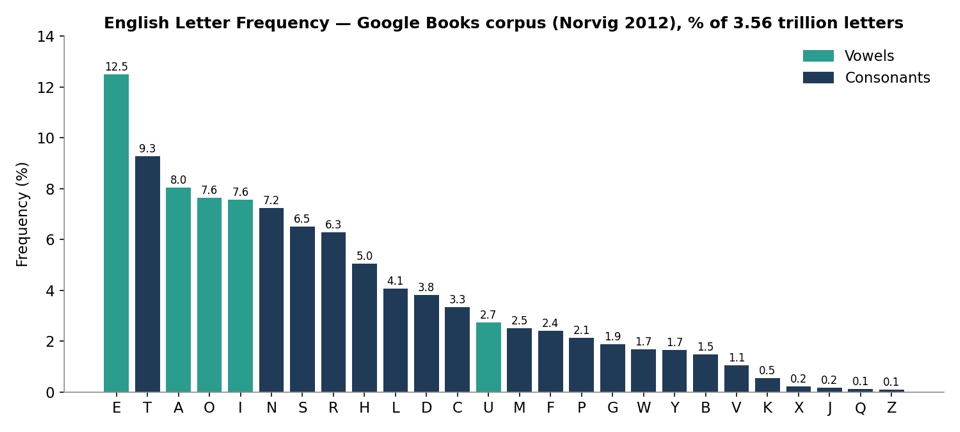
The best large-scale public dataset is Peter Norvig's analysis of the Google Books corpus: 97,565 distinct words mentioned 743.8 billion times, containing 3.56 trillion letters (full counts at norvig.com). Corpus percentages below are his; word-shape statistics elsewhere in this guide (affix rates, digraph rates, the QU ratio) come from a 234,210-word word-list analysis and are approximate — a different word list shifts them slightly. Three facts from the tables do real work while you play:
- E, T, A, O, I, N, S, R cover over half of all text. If your hypothesis uses only these hyper-common letters, thousands of words fit — distrust it and look for a rarer anchor. Conversely, a scramble made of these letters is statistically likely to be a common everyday word, so try common candidates first.
- Position matters. T is the most common first letter, O the most common second, and E is the most common last letter — an E in your rack is far more likely to end the answer than to start it. This dovetails with the finding that word edges anchor identity.
- Bigrams are the chunks your brain retrieves. The top ten bigrams alone account for over 21% of all two-letter sequences, and -TION is the most frequent four-letter sequence in English — exactly the suffix the affix-peeling technique tells you to test first.
| Letter | Frequency (%) | Letter | Frequency (%) | Letter | Frequency (%) |
|---|---|---|---|---|---|
| E | 12.49 | L | 4.07 | W | 1.68 |
| T | 9.28 | D | 3.82 | Y | 1.66 |
| A | 8.04 | C | 3.34 | B | 1.48 |
| O | 7.64 | U | 2.73 | V | 1.05 |
| I | 7.57 | M | 2.51 | K | 0.54 |
| N | 7.23 | F | 2.40 | X | 0.23 |
| S | 6.51 | P | 2.14 | J | 0.16 |
| R | 6.28 | G | 1.87 | Q | 0.12 |
| H | 5.05 | — | — | Z | 0.09 |
Bottom line: treat the top eight letters (E T A O I N S R) as your "common word" signal and the bottom five (K X J Q Z) as anchors. A hypothesis built only from the top eight discriminates poorly; a rack containing the bottom five practically names its own search space.
| Rank | Bigram | % of bigrams | Rank | Bigram | % of bigrams |
|---|---|---|---|---|---|
| 1 | TH | 3.56 | 6 | RE | 1.85 |
| 2 | HE | 3.07 | 7 | ON | 1.76 |
| 3 | IN | 2.43 | 8 | AT | 1.49 |
| 4 | ER | 2.05 | 9 | EN | 1.45 |
| 5 | AN | 1.99 | 10 | ND | 1.35 |
Bottom line: when a rack can form TH, HE, IN or ER, glue that pair first and build outward toward the word's edges — you are handing your word-recognition system exactly the retrieval cue it is built to consume.
Here is how frequency knowledge converts guessing into pruning. A seven-letter rack has 5,040 possible arrangements — but applying the constraints one at a time collapses the space. Take the rack from earlier, A E L P R S T (candidate counts from an exhaustive enumeration against the word list):
| Step | Constraint applied | Candidates left | Space eliminated |
|---|---|---|---|
| 0 | Raw permutations of 7 letters | 5,040 | — |
| 1 | Must contain a plausible common bigram (e.g., ST) | 720 | 86% |
| 2 | ST placed at a word edge (the anchor positions) | ~240 | 95% |
| 3 | Vowel/consonant skeleton must alternate plausibly | ~60 | 99% |
| 4 | Must be a real, reasonably common English word | 2 — PLASTER, STAPLER | 99.96% |
Bottom line: you never enumerate 5,040 arrangements — you stack two or three constraints and let frequency do the pruning. One warning from the same rack family — E I L N S T yields LISTEN, SILENT, ENLIST and TINSEL, all common words. When several answers fit the letters, more shuffling will not disambiguate them. Something else has to — and in Bubble Word Jam, that something is the category.
How do category puzzles change the strategy?
Bubble Word Jam is not a bare anagram game: every word on the board belongs to a hidden category, usually in groups of four. That category is a hard constraint you should apply before, not after, letter manipulation. The research backs this up — classic semantic-priming experiments showed that a related cue (reading "table" before unscrambling CHAIR) measurably shortens solution time, because the category pre-activates the answer in memory. Instead of "what words can these letters make?", ask "which members of this category can these letters make?" — a search space orders of magnitude smaller.
- Generate exemplars first. Before touching the letters, silently list 5-8 central category members — for "Shades of Blue": Navy, Azure, Teal, Cobalt…
- Match letters against the exemplar list. Check which exemplar your rack can spell. This turns search into recognition.
- Forage by subcategory. Category-fluency research shows people retrieve in bursts — fruits, then vegetables, then grains. Exhaust one subcategory, then deliberately switch.
- Prefer central exemplars. Puzzle designers sample from the middle of categories: try APPLE before GUAVA, DOG before DINGO.
- Hold the category loosely. If you fixated on the wrong subcategory, the theme becomes a misleading cue. Drop it, solve as a plain anagram, and let the letters talk.
The one twist Bubble Word Jam adds is the trap word: a word like Bow or Mint that legitimately fits two categories on the same board. Roughly 10,422 words in our database fit two or more categories — our trap-words field guide catalogs the worst offenders and a 4-step placement method. And because the game recycles categories heavily — Opera, Violin, Insects and Pottery lead our count of 39,508 category slots — knowing what repeats is its own edge: see the category-patterns guide for the full frequency tables, then browse the level index to see the categories in game order.
Does practice actually make you faster?
Yes — with one honest caveat. The strongest evidence comes from competitive Scrabble, where expertise is built almost entirely on word study and anagram drills. Competitive players read vertically printed words far better than controls and show "semantic deemphasis" — they process words as letter patterns, not meanings — while differing from non-players only on game-specific skills. Brain imaging confirms it: experts recruit working-memory and visual-perception regions where typical readers use semantic ones. And a study of how that expertise is acquired found the top performers got there through deliberate practice — solitary drills targeting weak spots — not merely games played.
The caveat: transfer studies show the gains are large but specific. Scrabble experts' advantages barely generalize beyond the game's demands, and the broader brain-training literature finds strong near transfer but weak far transfer. So grinding levels will not raise your general intelligence — but it will make you dramatically faster at jumbles, because that is precisely the trained skill. Practice like it matters: short daily sessions beat weekly marathons, drill pattern noticing before speed, and add timed rounds only after chunk recognition is automatic.
What mistakes slow solvers down?
- Random shuffling with no structure. Reshuffling without locking a bigram or peeling an affix just re-rolls the dice; always carry at least one constraint into the next shuffle.
- Marrying a wrong chunk. Perceived -ING or -TION chunks are cognitively sticky. If the leftover letters do not resolve within a few seconds, break the chunk and move on.
- Ignoring the rare letter. Solving around the Q or K instead of from it wastes the strongest constraint on the board.
- Trying obscure words first. Solution-word frequency is the strongest predictor of difficulty — puzzles overwhelmingly use common words, so test the everyday candidate before the exotic one.
- Solving letter-first in a category game. In Bubble Word Jam the category shrinks the space more than any bigram table; generate exemplars before rearranging bubbles.
- Staring instead of incubating. Fixation decays during a break, not during more staring. Skip and return.
FAQ
What is the fastest way to solve a word jumble?
Split the vowels from the consonants, lock any forced pairs like QU, peel off common affixes such as -ING, -ED, -ER, UN- or RE-, then solve the small core that remains. This shrinks a 7-letter rack from 5,040 possible arrangements to a handful of plausible candidates.
Why do some word jumbles feel impossible?
Three research-backed reasons: the solution is a low-frequency word (word frequency is the single strongest predictor of difficulty), the scramble is itself easy to pronounce as a fake word, which hijacks your reading system, or the letters contain a tempting wrong chunk — like an -ING that does not belong in the answer — that your brain refuses to break apart.
Which letters should I unscramble first?
The rarest ones. Q, Z, X, J and K each appear in well under 1% of English text, so any answer must come from the small set of words containing them. Lock Q to U immediately — 99.6% of words with a Q also contain QU — and anchor a K with -CK, -SK or -NK endings.
What are the most common letters in English?
E leads at 12.5% of all letters in Peter Norvig's count of 3.56 trillion letters from Google Books, followed by T (9.3%), A (8.0%), O (7.6%), I (7.6%), N (7.2%), S (6.5%) and R (6.3%). Together those eight letters account for over half of running text.
What are the most common word endings worth checking?
Among dictionary words the most productive affixes are UN- (6.2%), -LY (4.9%), -ER (4.7%), -AL (4.5%), -ED (3.9%), -NESS (3.0%), -TION (2.5%), -ING (2.4%) and RE- (2.3%). About 28% of seven-letter words carry at least one common affix, so test for one before random shuffling.
Does knowing the puzzle's category actually help?
Yes. Semantic-priming experiments show that a related cue — for example reading "table" before unscrambling CHAIR — measurably shortens solution time, because the category pre-activates the answer in memory. List 5-8 central category members first, then check which one your letters can spell.
Can practice really make you faster at anagrams?
Yes, and the gains are large but specific. Studies of competitive Scrabble players show that dedicated anagram drills reshape visual word recognition — experts literally process words as letter patterns rather than meanings — but the improvement stays in the practiced domain instead of raising general cognition.
What should I do when I am completely stuck on a jumble?
Stop working on it. A meta-analysis of 117 incubation studies found that setting a problem aside improves solution rates, because the break lets your wrong fixation decay. Shuffle the tiles, play a different level, and come back — it is a technique, not a surrender.
Will these tips work on every word jumble?
No — and any guide that promises that is overselling. When the answer is a genuinely rare word, or when several common words share the exact same letters (LISTEN, SILENT, ENLIST, TINSEL), no letter technique can settle it alone; the category constraint or in-game feedback has to. For those boards the honest move is to check the answer, then study the pattern you missed.
Do anagram solver tools count as cheating?
Bubble Word Jam is single-player, so there is no opponent to cheat — the only thing you can spoil is your own practice. Looking up every jumble means the pattern-recognition skill never gets trained. A workable rule: solve by hand first, use a solver or answer key for the one stubborn word, then note why you missed it.
How is Bubble Word Jam different from a newspaper jumble?
A newspaper jumble is one standalone anagram; Bubble Word Jam gives you a full board of words grouped by hidden categories, usually four words per category. The category is an extra constraint that shrinks the search space — but trap words that fit two categories at once are the game's signature difficulty.
Put the loop to work
- ✓ Matches your exact level version from any 2-3 words
- ✓ Tracks reshuffled versions other answer sites miss
- ✓ Free, no sign-up, answers in seconds
- ✓ Every level 1-1500, categories in game order
- ✓ Spoiler shield — reveal only what you need
- ✓ Works even when all you know is the level number